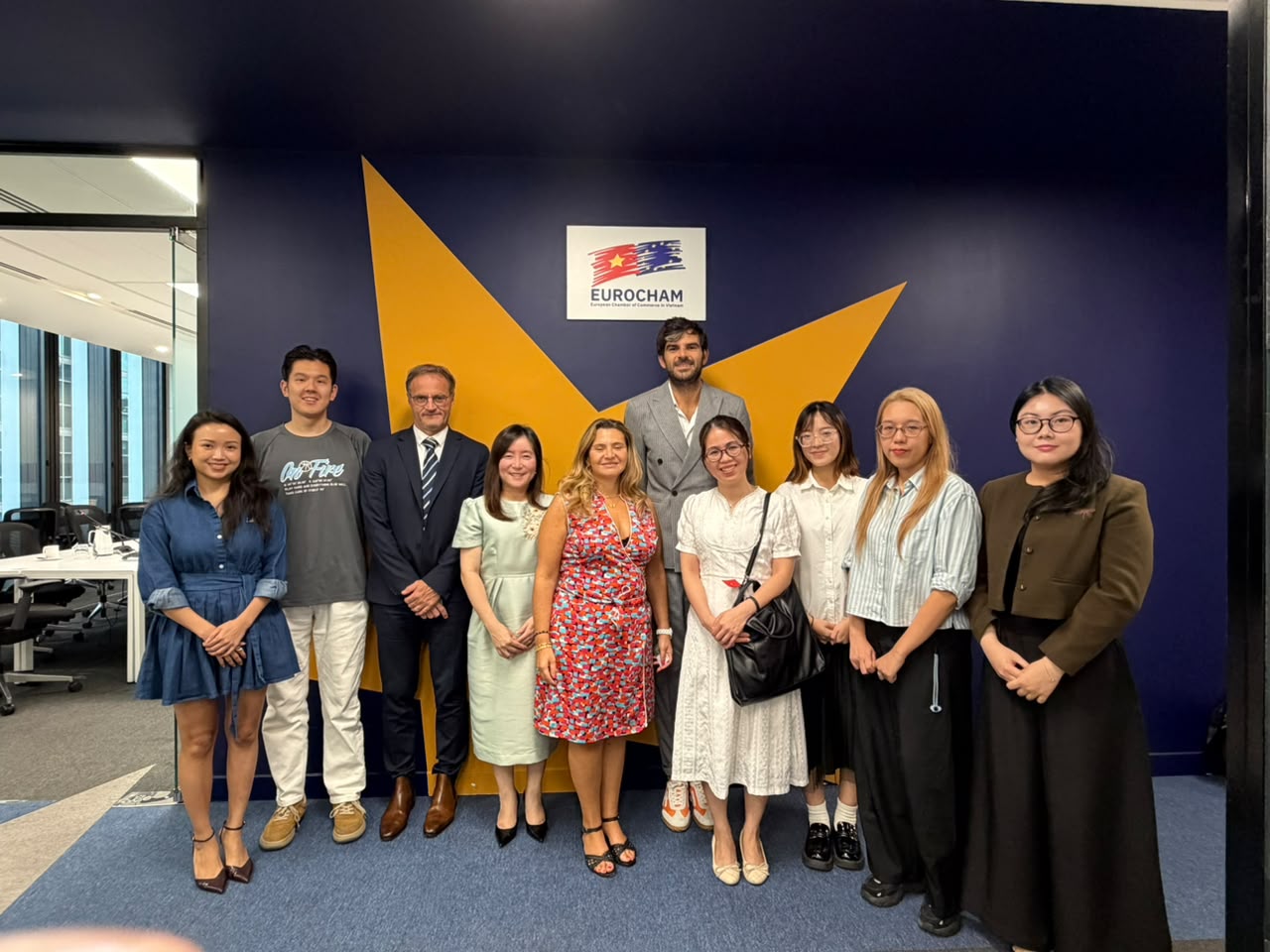
EuroCham and EU Delegation Deepen Trade Dialogues to Advance Business Environment

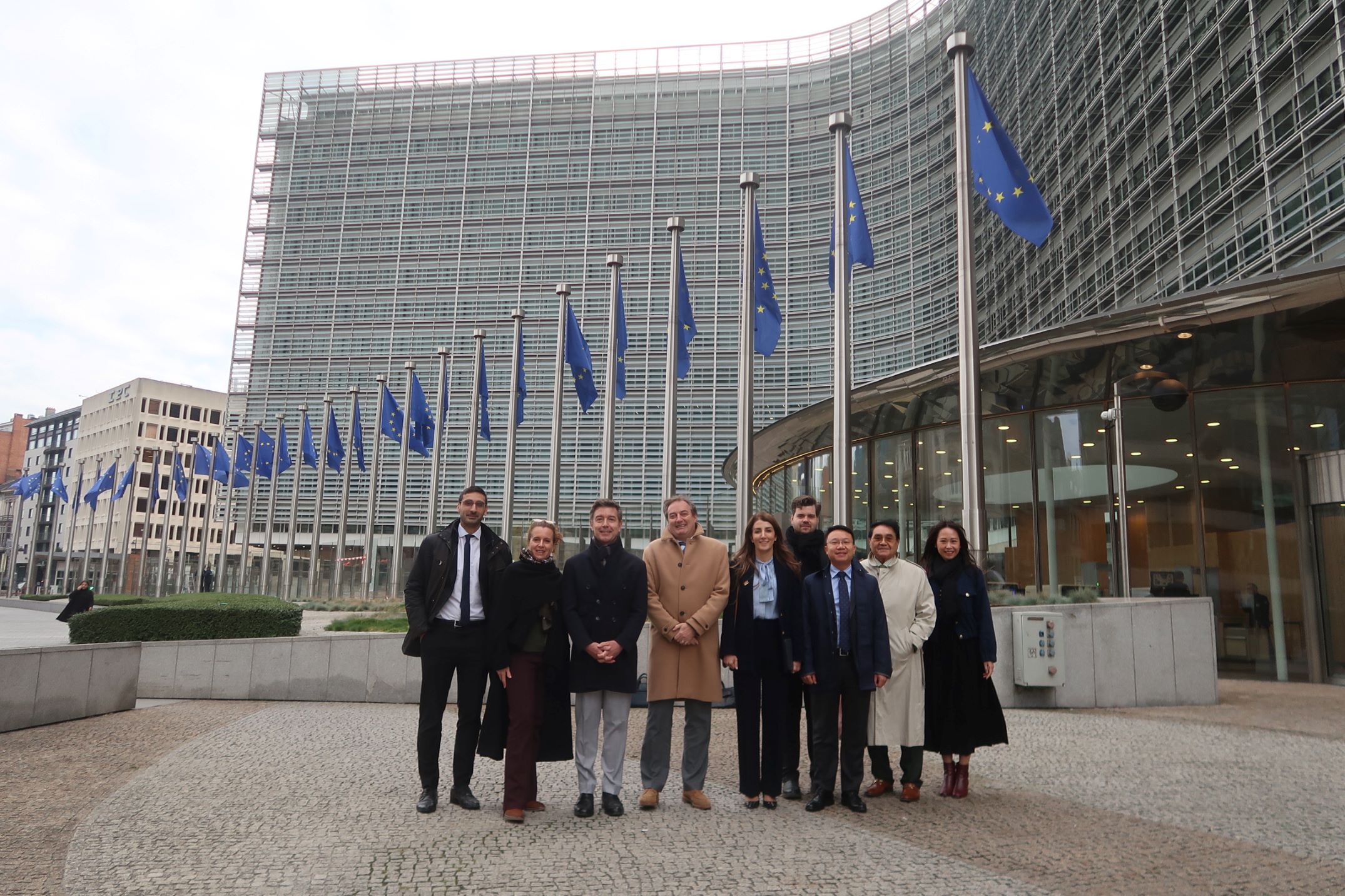
On 4 December, EuroCham Vietnam welcomed the EU Delegation’s Trade Team to our HCMC office for a series of in-depth meetings with EuroCham’s Sector Committees. The delegation was led by Mr. Ulrich Weigl (Head of Trade Section), alongside Mr. Laurent Lourdais (Deputy Head), and Mr. Ky Anh Le (Economist & Trade Specialist). 

EuroCham was represented by Mr. Jean-Jacques Bouflet, Vice Chairman in charge of Advocacy; Ms. Delphine Rousselet, Executive Director; Ms. Van Nguyen, Head of Hanoi Office & External Relations Manager; and leadership from the relevant Sector Committees.  

Discussions spanned a wide range of trade and regulatory issues: from green growth, pharmaceuticals, medical devices, cosmetics, to food safety, agriculture, automotive, digital policy, wine and spirits. 

Across all sessions, EuroCham and the EU Delegation reaffirmed their shared commitment to transparent dialogue, evidence-based policymaking, and a stable, predictable business environment for European companies in Việt Nam. These meetings mark an important step in strengthening cooperation and advancing solutions across multiple strategic sectors.  

The summaries below follow the sequence of the meetings’ agenda.

The European Standard Medicines Sector Committee (ESM), represented by Chairman Mr. Gregory Charitonos and Vice-Chairs Mr. Aleksandrs Parfjonovs and Ms. Magdalena Krakowiak, highlighted: 

  • Procurement restrictions on Foreign-Invested Enterprises (FIEs) 
  • Challenges in drug registration 
  • Obligations for technology transfer when seeking market access 
  • The need for a fairer, more transparent licensing and approval system 

The Pharma Group (PG), represented by Ms. Thuy Nguyen, PG Director, updated the Delegation on new developments under the Pharmaceutical Law, its guiding regulations, and the National Reimbursement Drug List. PG also reaffirmed its commitment to strengthen long-term cooperation with the EU Delegation in three key areas: 

  • Regulatory convergence 
  • Information sharing 
  • Capacity building 

The EU Delegation noted concerns about the lack of official tracking for dossier approvals and the perceived link between approval speed and technology-transfer commitments. Both sides agreed on the need for greater transparency, predictability, and recognition of generics in strengthening patient access and encouraging long-term EU investment. 

The Cosmetics SC, represented by Co-Chair Ms. Mai Tran, provided detailed analysis about the draft Decree on Cosmetics Management, noting: 

  • Excessive administrative steps for pre- and post-market procedures 
  • Mandatory labelling requirements that pose disproportionate compliance burdens  

The EU Delegation confirmed that the European Commission has already assigned a dedicated case team and has formally raised the issue with the Vietnamese Prime Minister. 

The Medical Devices & Diagnostics Sector Committee (MDDSC), represented by Chairman Mr. Fabian Singer, acknowledged Vietnam’s progress toward its first Medical Device Law but highlighted ongoing challenges: 

  • Unpredictable regulatory changes in a heavily import-dependent market 
  • National centralised procurement limiting hospital autonomy 
  • Lack of reimbursement pathways for advanced technologies 

The EU Delegation expressed readiness to support policymaking and encouraged the Committee to propose baseline principles to guide future engagements. 

The Food, Agriculture & Aqua Business (FAABS), represented by Co-Chair Mr. Paul-Antoine Croizé, outlined key priorities: 

  • Combating antimicrobial resistance (AMR) 
  • Recognition of international testing results 
  • Reducing reliance on in vivo testing 
  • Strengthening sustainable agricultural value chains 
  • Advancing EVFTA implementation 

The EU Delegation will review for next steps following FAABS recommendations on establishing WOAH/OIE-aligned disease-free zones and EU-recognised analytical data to avoid unnecessary testing burdens. 

The Mobility SC, represented by Mr. Thanh Do and Mr. Hue Hoang, raised key challenges for EU automotive companies: 

  • Delays in EVFTA implementation affecting importation of vehicle parts 
  • Proposed fuel-consumption limits for cars and motorcycles 
  • Taxation concerns 
  • Restrictions in Low Emission Zones (LEZs) 

The EU Delegation shared that the issues have been raised with the EU Trade Commissioner and MOIT, with positive signals for upcoming solutions. Both sides committed to continued dialogue on green transition measures and fair taxation policies for the automotive sector. 

The Green Growth Sector Committee (GGSC), represented by Co-Chair Mr. Jonathan Sourintha, outlined regulatory barriers delaying more than €1.5 billion in ready EU green investments, and proposed: 

  • Fast-track permitting 
  • Mutual recognition of sustainability standards 
  • Dedicated “Green Investment Lanes” 

The EU Delegation in turn shared timely updates on CBAM, CSDDD, eco-design, Digital Product Passports (DPP), and waste policy, and encouraged submission of company-specific cases to strengthen technical support and unlock high-impact projects. 

The Digital Sector Committee (DSC), represented by Co-Chair Mr. Bruno Sivanandan, discussed Vietnam’s fast-evolving digital regulatory environment, covering data, e-commerce, AI, and fintech laws. The EU Delegation identified four cooperation pathways: 

  • Embedding digital priorities into EU-funded programmes 
  • Utilising the EVFTA Working Group to escalate issues 
  • Preparing coordinated inputs for the EU-chaired CPTPP digital agenda in 2026 
  • Exploring pilot projects via the HCMC DX and 4IR Centres 

Both sides reaffirmed the importance of regulatory predictability to support EU digital investment in Vietnam. 

The Wine & Spirits Sector Committee (WSSC), led by Chairman Mr. Olivier Fages and Board Member Mr. Thang Tran, raised several priority issues: 

  • Significant decline in EU spirits exports 
  • Risks posed by the amended Special Consumption Tax Law 
  • The persistent issue of illicit alcohol 
  • Ambiguities in the draft national technical regulation on alcoholic beverages 

The Committee urged the EU Delegation to advocate for fair taxation, impact assessments, clearer definitions, EU-aligned testing requirements, and WTO notification.  

Related post

Marieke Van Der PIJL

VICE CHAIR

Corem ipsum dolor sit amet, consectetur adipiscing elit. Nunc vulputate libero et velit interdum, ac aliquet odio mattis.