
[Ho Chi Minh City, 15 April 2026] The European Chamber of Commerce in Vietnam (EuroCham) has released the Q1 2026 edition of its Business Confidence Index (BCI), revealing a pragmatic recalibration among European investors. The index stands at 72.7, down 7.3 points from its recent peak of 80.0 in Q4 2025, reflecting a more cautious outlook amid rising geopolitical tensions. Yet, the index remains well above levels recorded over the past four years, reinforcing a consistent message emerging from the data: while global turbulence is influencing short-term sentiment, Vietnam’s long-term appeal remains firmly intact. Notably, a remarkable 93% of European business leaders say they would recommend Vietnam as an investment destination, among the strongest endorsements in the history of the survey.
Conducted by DXL Research and Consulting, the latest BCI report delves deeper into the anatomy of investor resilience. It maps how different supply chain configurations shape risk exposure and outlines the critical regulatory reforms that investors expect from Vietnam’s newly elected Government to sustain long-term momentum.
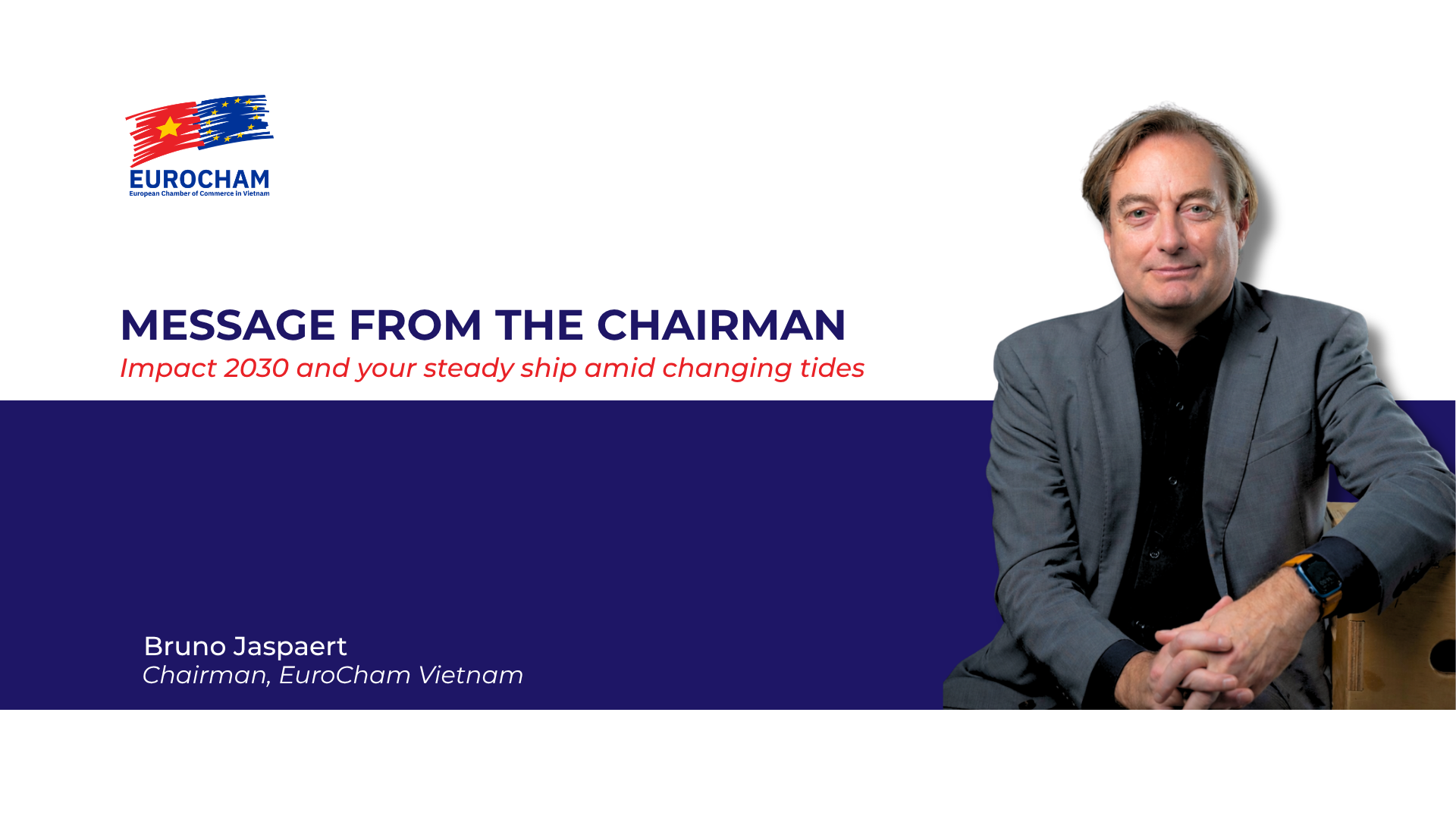
“What we are witnessing in Q1 is not a retreat, but a necessary recalibration,” commented EuroCham Chairman Bruno Jaspaert. “The global economy today resembles a shipping route passing through rough waters, particularly tensions in the Middle East that are driving energy price volatility and supply chain adjustments. In times like these, companies look for safe harbours where they can dock with confidence. The BCI data shows that while the geopolitical weather outside may be stormy, Vietnam’s economic foundations remain resilient. “

Explore the full BCI Q1 2026 report here: English version | Vietnamese version.
Click here for an in-depth look at the BCI score across various company sizes and sectors.
The Global Storm: Navigating Geopolitical Fault Lines
The shadow of global trade tensions looms large over the 2026 planning cycle. One year after the United States’ sweeping trade policy announcements on its so-called “Liberation Day” on 2 April 2025, businesses are still adjusting to a more fragmented and unpredictable global trading environment.
At the time, EuroCham conducted a rapid survey to capture the immediate reaction of European companies operating in Vietnam. The results showed that more than 70% of respondents expected “High” or “Very High” volatility, prompting many firms to revise revenue projections downward and adopt more cautious operating strategies. Most companies anticipated financial losses linked to tariffs, typically estimating a 20% reduction in their bottom line.
The latest BCI report for Q1 2026 provides a reflection on how businesses have actually performed since then. The findings point to a far more resilient outcome than many initially feared. Despite persistent geopolitical uncertainty, 77% of European businesses operating in Vietnam managed to maintain or increase their revenue in 2025, with 40% reporting revenue growth. While 23% experienced declines, most were moderate, suggesting that global tensions have tempered expansion rather than derailing it altogether.

The data ultimately reinforces Vietnam’s role as a stabilising node within global supply chains: a market where long-term fundamentals continue to outweigh short-term geopolitical turbulence.
Today, however, the nature of risk is evolving. Businesses are no longer focused solely on trade disruptions but increasingly on the secondary economic effects of global instability, mainly tied with the prolonged conflict in the Middle East. Energy and fuel price volatility has emerged as the most widely cited concern, affecting 75% of surveyed businesses, followed by rising operating costs (61%) and the risk of a slowdown in global demand (55%). Altogether, 90% of respondents identify cost pressures and geopolitical conflicts as the defining risks for the year ahead.
This shift highlights a broader dynamic shaping the business outlook for 2026. The challenge facing investors in Vietnam is no longer about whether opportunities exist, but rather how efficiently companies can capture them in an environment characterised by higher costs, supply chain adjustments, and greater operational complexity.

The Anatomy of a Moderating Confidence
The 7.3-point drop in the BCI from the end of 2025 reflects these broader global anxieties. However, the moderation should not be mistaken for a structural shift in investor confidence. In fact, 56% of businesses still reported positive operational performance in Q1, supported by strong seasonal activity following the Tet holiday period. Expectations for the near-term future have simply become more cautious. Neutral outlooks rose to 38%, while negative expectations edged up slightly to 10%.
This moderation, however, is not uniform. It reveals a highly fragmented landscape where confidence is influenced by sector, scale, and market exposure.
Company size also acts as a crucial variable. Larger firms, particularly those with more than 50 employees, continue to report robust sentiment, equipped with the operational buffers necessary to absorb global shocks. In contrast, confidence remains notably weaker among smaller businesses, particularly those with 11–25 employees (scoring a low of 65.5).
Market exposure is another key driver of sentiment. Companies primarily focused on Vietnam’s domestic market report significantly higher confidence, with a BCI score of 77.4, well above the overall average. Whereas, firms with heavier exposure to external markets, especially the United States and the Middle East, or broader global supply chains, show lower confidence levels, reflecting their greater sensitivity to on-going geopolitical disruptions and external demand fluctuations.
Xavier Depouilly, General Manager of DXL Research and Consulting, explained that these variations highlight how different business models absorb global shocks. “Our new analysis mapping confidence to geographical revenue sources shows that companies focused on the domestic market are navigating the slowdowns more comfortably, which is why we see higher confidence levels there. Unquestionably, companies that are more exposed to international supply chain, particularly those trading directly with the Middle East, feel the pressure the most acutely. A good balance between Vietnam and relatively more stable markets such as Europe, can act as a stabiliser for investors against geopolitical shocks.”
The Reality Check: Performance vs. Expectations
While overall sentiment remains in positive territory, actual reported performance in Q1 fell short of the high expectations set at the close of 2025. Businesses anticipated a 69% positive performance but realised a 56% rate.

This 13-point gap does not indicate a piercing deterioration in market conditions, but rather highlights the impact of slower deal conversions, cost pressures, and external uncertainty that have moderated actual growth.
For companies that reported a successful quarter, the primary driver remains straightforward: commercial growth. Around 36% cited direct sales and revenue expansion as the main factor behind positive performance.
For those experiencing neutral or weaker outcomes, the challenge is rarely a single disruptive shock. Instead, many describe a gradual accumulation of many variables. Mounting operational pressures, slower execution speeds, softer external demand, and cost-pricing imbalances are combining to make rapid growth more difficult to sustain.
Vietnam’s Enduring Magnetism
Despite these near-term headwinds, confidence in Vietnam as a premier investment destination remains strong. An impressive 93% of European businesses say they would recommend the market, which is among the highest endorsement levels in the history of the BCI. European companies are decoupling short-term operational frictions from their long-term strategic outlooks.
At the sector level, confidence is particularly strong in Agriculture & Food and Tourism & Hospitality, both reaching full recommendation levels of 100%. Across company sizes, variation remains limited, confirming that Vietnam’s value proposition is broadly compelling regardless of scale.
The relationship between strategic commitment and business performance is particularly striking. Companies that position Vietnam as a central market in their regional strategy are significantly more likely to report positive performance outcomes. Among these firms, between 65% and 68% report positive business performance, and 96% say they would recommend the country as an investment destination. By contrast, companies with only a limited or cautious presence in Vietnam show far weaker results, with just 23% reporting positive performance and less than half recommending the market, dwarfing the metrics slightly.

“Our members distinguish between the operational hurdles of today and the strategic dividends of tomorrow,” Chairman Jaspaert noted. “When over nine out of ten businesses continue to champion this market, it speaks volumes about Vietnam’s extraordinary potential for growth. The sustained GDP performance we are seeing, with Q1 2026 expanding by 7.83% – outpacing the same period last year, reinforces this confidence. The numbers in this BCI proved that the deeper companies anchor their operations in Vietnam, the more financially resilient they become, even when the broader global picture is fraught with risk.”
An Evolving Business Environment
While global pressures dominate the headlines, the survey also highlights structural challenges within the domestic business environment that continue to affect operational efficiency.
Administrative hurdles remain the most frequently cited constraint. In the latest survey, 61% of businesses identified ‘administrative procedures and paperwork’ as a key challenge, up from 53% in the previous quarter. Close behind are the ‘unclear or inconsistently applied regulations’, as well as ‘tax administration’, reported by 51% and 44% of respondents, respectively.
Concerns over ‘talent shortages and staff turnover’ rose from 23% to 33%, suggesting that human resource constraints are emerging as another factor affecting business operations.
There are, however, signs of progress in certain areas. Businesses reported some improvement regarding overlapping government requirements as well as visa and work permit procedures, though these gains remain secondary compared to the broader administrative and regulatory burden.

For companies on the ground, these issues translate into tangible business impacts. Many companies report higher operating costs, slower business execution, and the diversion of management resources away from core business activities. For investors, regulatory complexity is also reducing planning visibility and affect competitiveness in an increasingly competitive global investment landscape.
A Policy Roadmap for the Next Growth Phase
Through it all, businesses remain clear about the reforms that could further strengthen Vietnam’s investment climate. Infrastructure development, streamlined administrative procedures, and faster decision-making processes are consistently identified as the most impactful areas for policy action. Sector priorities differ slightly: Tourism emphasises infrastructure and workforce development, while Agriculture focuses on regulatory clarity. The overarching message remains consistent: predictability and efficiency are the key drivers of competitiveness.
EuroCham looks forward to expanding on these insights during the upcoming Whitebook Dialogue Week, where our 20 Sector Committees will engage directly with ministries and government counterparts to translate business feedback into practical policy improvements. The platform offers an opportunity to move beyond identifying challenges toward shaping solutions, helping bridge the gap between strategic ambitions and operational realities on the ground.
Chairman Jaspaert emphasised that the horizon ahead is bright: “The continued leadership of Party General Secretary and President Tô Lâm sends an encouraging signal of stability and long-term vision. At the same time, the newly elected Government has also highlighted the focus on private economy as a key driver of growth. These are exactly the foundations investors look for when making long-term commitments. As Vietnam enters this era of rising, competitiveness will increasingly depend on execution: easing administrative burdens, decentralising decision-making, and ensuring greater regulatory clarity. EuroCham stands ready to work closely with the Government and our partners to turn these priorities into real outcomes, ensuring that Vietnam’s strong growth story continues to attract investment, innovation, and sustainable development.”
###
About EuroCham Vietnam
Founded in 1998, the European Chamber of Commerce in Vietnam (EuroCham) has established itself as the unified voice of the European business community in Vietnam. With offices in Hanoi and Ho Chi Minh City, we represent a diverse spectrum of companies, ranging from small and medium-sized enterprises to multinational corporations. EuroCham plays a crucial role in shaping policy dialogues, fostering bilateral trade and investment, and fortifying economic ties between Europe and Vietnam, particularly within the framework of the EU-Vietnam Free Trade Agreement (EVFTA).
EuroCham Vietnam boasts a substantial membership base comprising over 1,400 companies, solidifying its position as one of the largest foreign chambers operating in Vietnam. We unite nine prominent national European business associations in Vietnam, which include:
EuroCham’s diversified influence is underpinned by our extensive network of 20 specialised Sector Committees. Serving as think tanks within their respective industries, these committees provide invaluable expertise, steer policy recommendations, and stimulate industry-specific dialogues. This organisational framework guarantees that the concerns and viewpoints of diverse sectors are actively considered, thereby moulding EuroCham’s cross-sectoral agenda and magnifying its overall influence.
For more information about EuroCham, visit: www.eurochamvn.org.
For media enquiries, please contact:
EuroCham’s Senior Media & Communications Officer
Ms. Tram Hoang – tram.hoang@eurochamvn.org